
Fleet Advertising Comparison for Smarter Branding
A service van stopped at a red light can get more attention than a billboard people drive past every day. The right fleet advertising comparison helps you decide how much of that attention your company needs, what it should cost, and which option will still look sharp after months of Florida sun, job sites, and daily miles.
For contractors, delivery teams, home-service businesses, and growing local brands, the choice usually comes down to commercial decals, partial wraps, or full vehicle wraps. All three can turn a plain vehicle into a business asset. They do not, however, deliver the same visual impact, coverage, or long-term branding value.
Fleet Advertising Comparison: Decals, Partial Wraps, and Full Wraps
The best option is not automatically the biggest or most expensive one. It is the format that makes your company recognizable at the speed and distance people actually see your vehicles. A plumber with five white vans, for example, may need bold consistency across every vehicle. A startup using one pickup may need a clean, cost-conscious first impression that is easy to expand later.
Commercial decals: clear branding on a tighter budget
Commercial decals are individual vinyl elements applied directly to the vehicle. They often include a logo, company name, phone number, website, service list, license number, or simple graphic accents. Decals are ideal when you need the vehicle to identify your business without dramatically changing its overall appearance.
This is often the right starting point for businesses with limited marketing budgets, leased vehicles, or a simple brand mark that does not require a large visual canvas. A clean logo on the doors, a phone number on the rear, and service information on the side panels can make a work truck look established instead of anonymous.
The trade-off is visibility. Small decals can be hard to read in traffic, especially on darker vehicles or from more than a few car lengths away. If the design is too text-heavy, people may notice there is branding without remembering who the vehicle belongs to. Decals work best when the message is focused and the logo has enough contrast to stand out.
Partial wraps: more impact without full coverage
A partial wrap uses printed vinyl graphics to cover selected areas of the vehicle, such as the doors, rear panels, hood, tailgate, or a large section of the sides. The original paint color remains visible and becomes part of the design. With a strong layout, a partial wrap can create the appearance of much more coverage than it actually has.
For many small fleets, this is the sweet spot. It gives your brand room for large graphics, color blocks, service imagery, and readable contact information while controlling the project cost. A partial wrap can make a utility van, box truck, trailer, or pickup look custom-built for your company rather than simply labeled.
Partial wraps require careful design discipline. The vehicle color must support the brand palette, and the exposed paint should feel intentional rather than unfinished. A black truck may work beautifully with high-contrast white and bright-color graphics. A faded or mismatched vehicle can make even a well-printed wrap look less polished. Before choosing partial coverage, consider the condition and color consistency of every vehicle in the fleet.
Full wraps: maximum visibility and brand control
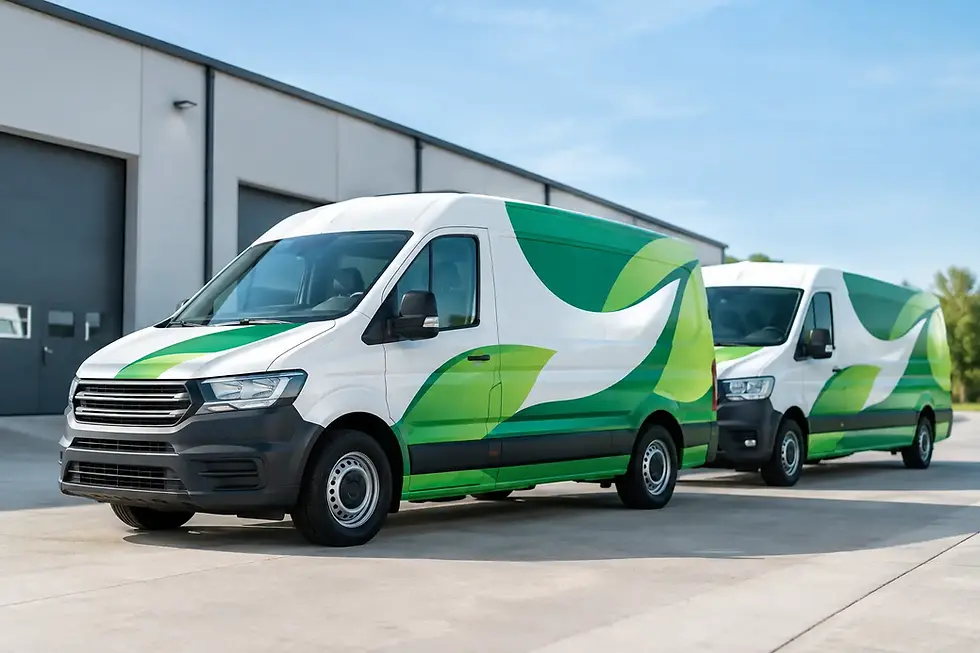
A full wrap covers nearly all painted exterior surfaces with custom printed vinyl. It gives your company complete control over color, photography, patterns, messaging, and the visual personality of the vehicle. It also creates the strongest roadside presence, which matters when your vehicles spend full days in neighborhoods, parking lots, highways, and active job sites.
A full wrap is especially effective for businesses that depend on local name recognition. HVAC companies, electricians, restoration teams, pest-control operators, food and delivery brands, and mobile service providers benefit when customers can identify them before reading a single line of copy. The goal is not to cram every service onto the vehicle. It is to make the brand instantly recognizable and easy to contact.
The larger investment comes with practical benefits. Full wraps can help protect the original paint from normal exposure, and they create a uniform look across vehicles that may be different makes, models, or colors. For a fleet manager, that consistency can be worth as much as the visual impact. Every van, truck, and trailer presents the same level of professionalism.
Compare Fleet Advertising by What Drivers Can Actually See
When evaluating coverage options, think beyond the design proof on a computer screen. Your audience usually sees a vehicle in motion, from the opposite lane, through rain, or while managing a busy intersection. The design needs to work in seconds.
A full wrap gives you the most space, but more space does not mean more information. The strongest fleet graphics typically lead with a recognizable logo, a clear service category, and one easy contact method. A partial wrap follows the same rule, using its available panels strategically. Decals have the least room, so every element must earn its place.
Vehicle type changes the equation. The tall, flat sides of a box truck can support large graphics and a more detailed brand story. A compact service van benefits from bold side-panel branding and a clean rear-door layout. Trailers can deliver major visibility because they offer broad, uninterrupted surfaces, but they need graphics sized for distance. A pickup with a tool bed may have limited smooth panel space, making door decals or a partial side treatment more practical.
Budget Is More Than the Initial Installation Cost
A low-cost option is not always the best value, and a full wrap is not always necessary. The real question is how much exposure your fleet creates and how consistently the vehicle supports your sales efforts.
Decals are generally the most affordable choice and can be installed quickly. They make sense for a newly launched business, an occasional-use vehicle, or a fleet that needs basic identification first. Partial wraps cost more because they require more design, printed material, and installation time, but they can deliver a major leap in visibility. Full wraps require the largest investment, yet they often make sense for high-mileage vehicles that represent the business all day.
Also factor in the cost of inconsistency. If one vehicle has a polished full graphic package and another has a small, peeling door logo, customers may assume the same uneven standard applies to your work. A coordinated fleet does not have to use identical coverage on every unit, but it should use the same colors, logo treatment, type style, and message hierarchy.
Design Choices That Make Fleet Graphics Work Harder
A great fleet design is not a brochure on wheels. It is a fast visual signal that tells people who you are and what you do. Large logos, high contrast, clean typography, and a limited message tend to outperform crowded layouts.
Your contact information should match how customers are likely to respond. A prominent phone number may be essential for emergency services. A memorable website can work well for companies with a longer research cycle. QR codes can be useful in parking situations, but they are not a substitute for branding that can be understood at 40 miles per hour.
Color matters in Central Florida. Bright sunlight can expose weak contrast and make thin text disappear. Premium vinyl and professional installation matter too, particularly on vehicles exposed to heat, rain, road grime, and frequent washing. Quality materials help graphics hold their color and edges, while experienced installers know how to work around curves, seams, handles, rivets, and complex body lines.
Choosing the Right Coverage for Your Fleet
Choose decals when your goal is clear identification, you need to control upfront spending, or your brand is simple enough to communicate with a few well-placed elements. Choose a partial wrap when you want a noticeable upgrade in visibility without covering the entire vehicle. Choose a full wrap when the vehicle is a primary marketing channel, brand consistency is a priority, or you want maximum impact in traffic.
For fleets, the smartest approach is often to create one strong visual system and adapt it to each vehicle type. A full wrap on a flagship box truck, partial wraps on service vans, and matching decals on support vehicles can all feel like one brand when the design is planned as a system from the start.
DLA Wraps handles design, printing, and installation in-house, so your fleet can move from a clear concept to a scheduled, professionally finished rollout without handing pieces of the project to multiple vendors. Bring photos or vehicle details to your consultation, think about where your team drives most, and choose the coverage that will make every mile count.


Comments